
How Children’s Hospital Colorado uses gaming to support SMA care
Written by |
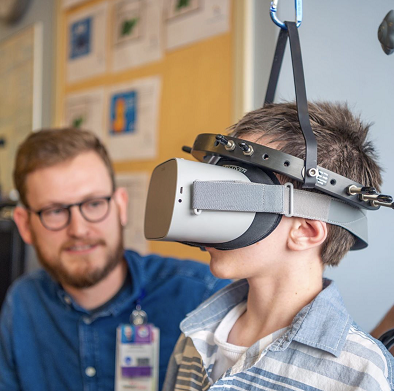
Abe Homer of Children's Hospital Colorado uses adaptive gaming tech to connect with young SMA patients. (Courtesy of Children’s Hospital Colorado)
Abe Homer’s entry into healthcare gaming technology began at Children’s Hospital Colorado, where he met a young man with advanced spinal muscular atrophy (SMA).
“He was a young man in his mid-20s, who was in a pretty advanced stage of SMA at that point, where he could only move his big toe. We quickly bonded over our mutual love of games and technology,” says Homer.
Homer customized gaming hardware for the patient’s limited mobility, setting him up with an adaptive controller so they could play video games together.
“It was so beneficial for him that we started scheduling these around his wound dressing changes. Every time he had some sort of procedure, he would request that I come and play a game with him, to help distract him from that pain.”
The patient, who had been hospitalized for three years due to his disease progression without prior access to video games, found renewed joy. Homer recalls the patient saying, “This is the happiest I’ve felt in a really long time.”
That experience confirmed Homer’s use of gaming and virtual reality (VR) as tools for emotional support and physical distraction during medical procedures — work he now applies across Children’s Hospital Colorado.
A career pivot shaped by caregiving
Long before he was leading a hospital gaming program, Homer’s relationship with video games and technology was already shaping his path.
While caring for his mother with stage 4 ovarian cancer, he found himself turning to games for mental respite — and began reconsidering his career in special effects.
“I was using games as a therapeutic mechanism for myself during that time,” Homer says, adding that this realization sparked an interest in exploring gaming’s potential in a healthcare setting.
Today, Homer leads a team of five at Children’s Hospital Colorado, which includes gaming technology specialists across multiple locations, a makerspace expert who manages 3D printers and laser cutters, and an in-house developer creating custom VR games.
Together, the team deploys video games, VR experiences, 3D printing, and robotics — from recreational play for long-term inpatients to VR alternatives for anesthesia during procedures — for patients ages 6 to 36 across various hospital departments.
Using VR to support specific treatment goals
The team’s VR designs focus on goals or “use cases,” such as minimizing anxiety during IV starts or easing the stress of transport to the operating room.
“We tailor our games to those specific use cases, those specific goals, [and] the needs of the providers,” says Homer, adding that an example is a VR experience transforming a scary hospital hallway into a magical winter wonderland during gurney rides to surgery.
The team also uses adaptive tools, such as 3D-printed controllers and custom software, to enable patients with advanced stages of SMA to participate.
“It depends on if we want kids to be immersed or to play on a screen, and if they’re physically able to use VR,” he says, adding that this flexibility ensures accessibility and engagement across different abilities and preferences.
How VR reduces pain and anxiety
Beyond immersing kids in game worlds, Homer says a neurological effect called “supersensory proprioception” is at work.
This phenomenon happens when VR engages a person’s brain so fully that it can override real-world pain signals, acting as an effective nonpharmacological substitute for opioids, especially during painful procedures like lumbar punctures.
“The most exciting thing we observe is your brain is so taxed by the visual and auditory inputs that it starts to convince your physiology that you’re not feeling things,” he says, adding that this means children experience significantly reduced pain and anxiety during treatments.
“If someone’s going to do a needle poke, it’s not like they’re saying, ‘Here comes the needle.’ Instead, maybe something lands on your arm in VR, and you’re mirroring that sensation,” he says.
Families also notice the difference when their kids can endure longer procedures or ask when they can return to use VR again, as the hospital environment transforms from a place of fear to one of fun and engagement.
Scaling VR across clinical settings
Homer also leads the Extended Reality (XR) program, bringing technologists, healthcare clinicians, and specialists together to implement VR safely and effectively hospitalwide.
“We act as both an educational resource and an implementation resource,” he says.
That coordination tackles real-world hurdles like infection control — hydrogen peroxide wipes and UV cleaning boxes are used to keep equipment safe — and scalable software design that serves diverse patients without providing custom games for each.
The future of VR in healthcare
Since introducing gaming technology in 2018 and expanding into VR in 2022, the work at Children’s Hospital Colorado has drawn attention from the broader medical community. Homer says the team is eager to share what they’ve learned.
“We present at conferences, and we share our games with anyone who asks. We’re an open book for anyone wanting to learn.”
Looking ahead, Homer is optimistic that alternative biometric inputs will further transform how VR is used in healthcare. “This means being able to control VR experiences with things other than controllers, things like eye gaze, your breath or respiration, your heart rate, your brainwaves,” he says.
Biometric inputs can open up a new world for children at the hospital, particularly for kids with SMA who might be in advanced stages of their disease and stuck in bed for a long time, he says.
“It’s pretty exciting to me, because I want all these kids to feel like they have independence and autonomy and can engage with the world as big and full as it is.”