
The logistics of hugging a friend with SMA
It may feel intimidating and uncomfortable if you aren’t familiar with it
Written by |
I’m getting ready for a trip to see my dear friend Christi get married this month. It’ll be the first time I meet her soon-to-be-husband in person, and from what she’s shared about him, I am so excited for that moment.
Apparently, she has told him a lot about me as well, including that I have SMA and am in a wheelchair. She told me recently that the part of the encounter he’s most concerned about is this: “How do I hug Connie?”
I laughed and asked her how she answered. Christi has hugged me a thousand times over the past 35 years, so if anyone would know what to say, surely it would be her. But she had no idea, because our hugs have become so natural for us. “I think you just put your arms around her and … hug her!”

Overcoming obstacles together
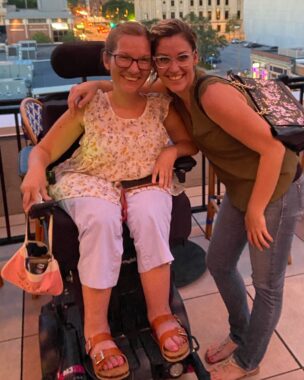
From left, columnist Connie Chandler and her friend Christi Perry share a side hug. (Courtesy of Connie Chandler)
This got me thinking about the logistics of hugging people with SMA. It may feel intimidating and uncomfortable if you aren’t familiar with it. There are barriers of strength and immunity to consider: You don’t want to squeeze too tightly or smother too much, and you don’t want to spread unnecessary germs that could pass on sickness.
And don’t forget the power wheelchair details: We don’t want to run over your toe, bruise your shin, or knock you down in the process, so please remember to hug from the opposite side of the joystick or mobility controls.
Hugs are supposed to be comforting and healing, not stressful and panic-inducing! So how can we overcome these obstacles together?
If you are an able-bodied person who wants to hug someone with SMA, don’t overanalyze it. The best thing you can do is ask — first if it’s OK, and then how to do it. (We actually think about this quite often, and it might impress you to hear what strategy works best for each individual.)
In the following suggestions, I will refer to the able-bodied person as “Hugger A” and the person with SMA as “Hugger B.”
A side hug is pretty basic, with Hugger A putting an arm around the back of Hugger B’s shoulders and giving a gentle squeeze. The height difference between the two people will determine how close they are, so if Hugger A wants to be closer, they may need to lower themselves in a chair or get down on their knees beside the wheelchair. This is the most common way I receive hugs.
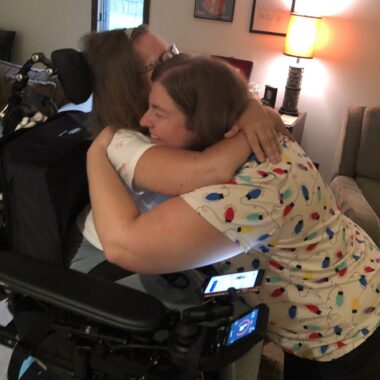
From left, columnist Connie Chandler and her friend Julie Smith share a bear hug. (Courtesy of Connie Chandler)
For Hugger B to reciprocate such a side hug, it’s helpful if Hugger A wraps their free arm around the front of Hugger B, like a full-circle embrace from the side. This way, Hugger B can put one hand on A’s front arm to pat or squeeze; it’s a small gesture, but it gives us a chance to participate.
Sometimes I want to be the hugger, especially if I’m with someone who is crying. This is hard for me because I cannot spontaneously wrap my arms around someone to comfort them the way I want to. But I can ask (and do): “Can I give you a hug?” Usually, they’ll lean in and put their head on my shoulder. It doesn’t really involve my arms, beyond putting my hand on them and rubbing their arm or their back. But at least it is a reassurance that I am there for them.
In my opinion, the bear hug is the most needed and least used hug for wheelchair users who really want to show some love. The key again is to get as close to the same shoulder level as possible, whether Hugger A has to sit or kneel, or Hugger B has to adjust their wheelchair to elevate or stand. Then Hugger A needs to help Hugger B wrap their arms around Hugger A’s neck. With floppy, low-tone arms, this is tricky for Hugger B, so if a third person is available to assist, recruit them! Get Hugger B’s hands locked together around Hugger A’s neck and get Hugger B’s elbows up over Hugger A’s shoulders. Then Hugger A will put their arms around Hugger B, and the two can hold each other and squeeze for as long as they want!
My friend Heather Dye (who is fellow columnist Halsey Blocher’s mom) says, “A hug is really that offering of: ‘I see you, I want to connect with you, and I want you to be known as somebody that I care about.'” Hugs are great for our physical, emotional, and mental health because they allow us to communicate and connect without words.
So now that you know, go hug a friend today!
Note: SMA News Today is strictly a news and information website about the disease. It does not provide medical advice, diagnosis, or treatment. This content is not intended to be a substitute for professional medical advice, diagnosis, or treatment. Always seek the advice of your physician or other qualified health provider with any questions you may have regarding a medical condition. Never disregard professional medical advice or delay in seeking it because of something you have read on this website. The opinions expressed in this column are not those of SMA News Today or its parent company, Bionews, and are intended to spark discussion about issues pertaining to spinal muscular atrophy.



Leave a comment
Fill in the required fields to post. Your email address will not be published.