
What a wooden stool taught me about people’s behavior
I usually cringe at people who stare, but here was someone seeking it out
Written by |

A stool. A chain. A person’s body.
None of these things is what I’d usually call “art materials,” but that’s exactly how contemporary Singaporean artist Amanda Heng sees them.
During a recent trip to the National Gallery Singapore, I discovered “Walking The Stool,” a 1999 performance by Heng and collaborators in which they, well, walked a stool around central Singapore.

I initially stopped at the performance reel that was on display to recall what Singapore looked like in the 1990s and early 2000s. As a late ’90s child, my memories of that period before the widespread use of the internet and smartphones are sadly hazier than a VHS tape. The buildings appeared the same as they are now, the fashion and the people less so. The public didn’t seem as international and multicultural as Singapore is now, and people looked like they were drowning in denim.
But as I watched, I was fascinated by Heng and the crowds around her. For most of my life, I’ve tried to avoid people staring at me as if I were an oddity. SMA made that a futile endeavor, though, because of course people will stare when your limbs are stick-thin, your parents move you around in a pram as your “wheelchair,” and you have a hunchback that developed after puberty. Heng, on the other hand, invited the stares.
Wait, what? Why?
Art as a mirror
There has always been a fine line between keeping the peace and censorship in Singapore. But 1994 kicked off at least a decade in which the performing arts were particularly frowned upon. In response to the controversial nudity of “Brother Cane,” a protest performance by Josef Ng following the mass arrest of several gay men, the Singaporean government froze public funding for the performing arts until 2004. As a result, Heng was required to sign an agreement that banned performances in a studio awarded to her by the National Arts Council in 1997.
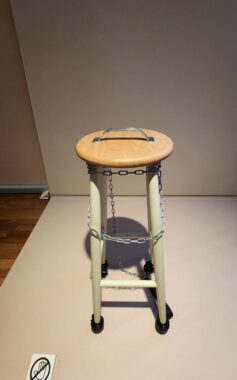
Artist Amanda Heng’s studio stool, which became famous in Singapore in the late 1990s, on display at the National Gallery Singapore. (Photo by Rachel Chen)
Heng’s response was to drag a stool on a chain outdoors.
At first, this choice might seem ridiculous. But the odd, disruptive nature of “Walking The Stool” was subtly and playfully brilliant: Because no one quite knew how to react to Heng and her collaborators, people’s reactions were instinctual. Most simply stared, but a handful of observers jumped in to help Heng lift the stool over curbs and stairs or walked with her to ensure that she was OK.
Though Heng and her collaborators were the performers, I was struck by the public’s behavior.
I was also reminded of the many reactions my disabled body has received in public. Not everyone has simply stared. Some ask questions about my condition, and others rush to help if my wheelchair is stuck somewhere. At least one person holds the elevator for me every time I’m out. They smile, and I smile back. The only reaction that truly annoys me is the unsolicited advice about how to manage my SMA, as if I don’t know my own condition.
Like Heng’s performance, my disability is disruptive enough to the norm that it ostensibly reveals who people are. There’s something inspiring about that; it implies that disabled bodies are works of art in their own right.
There’s also something encouraging about a nondisabled person going out of their way to take up space in society, both literally and figuratively, and ending up commemorated in a museum for their efforts.
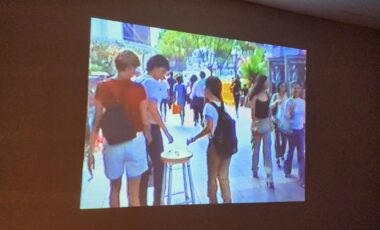
Video highlights of Amanda Heng’s “Walking The Stool” project in Singapore, in the late 1990s. (Photo by Rachel Chen)
Adults in my life often taught me to sit in a corner, to never be a burden to others, and to let go of arguments. Which is reasonable advice — no one wants a child they love to grow up to be a brat, or be perceived as one. But if you couple that with the pervasive ableism in society, that child could become a shrinking violet. I still apologize when strangers bump into my wheelchair.
Maybe I won’t mind people staring at me the next time I’m out. Perhaps, one day, I’ll even invite them to do it and see what happens.
Note: SMA News Today is strictly a news and information website about the disease. It does not provide medical advice, diagnosis, or treatment. This content is not intended to be a substitute for professional medical advice, diagnosis, or treatment. Always seek the advice of your physician or other qualified health provider with any questions you may have regarding a medical condition. Never disregard professional medical advice or delay in seeking it because of something you have read on this website. The opinions expressed in this column are not those of SMA News Today or its parent company, Bionews, and are intended to spark discussion about issues pertaining to spinal muscular atrophy.





Leave a comment
Fill in the required fields to post. Your email address will not be published.