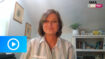















Eloise Pillarella shares how living with spinal muscular atrophy (SMA) shaped her journey from art student to middle school science teacher in New York City.
Transcript
Hello. I’m Eloise Pillarella. I’m 30 years old. I have spinal muscular atrophy type 2. I’m a seventh-grade science and math teacher. I’m from Staten Island and I live in Manhattan currently.
It was hard to kind of accept my disability as a younger child because I think the world is more all about like climbing and running and playing.
But as I got older, I just had a really great experience in middle school and high school. I made amazing friends. I got really into art, so I kind of had other outlets. So I love art. I love drawing.
When I was in high school, I had, like, a tutoring program for children that were at risk of, like, falling below in their reading level. So I tutored them, and I had so much fun. And then I went into college.
I majored in art education. And the first day of the art class, they gave us like a big giant saw to use, and I was like, there’s no way I’m going to modify this assignment to use a saw to cut wood.
And they were like, “You can do a little, tiny drawing.”
And I was like, “That’s not really the same.”
So I went into science education instead of art, even though science wasn’t really my passion. But I’m so happy I did because now it is my passion. I love to experiment and like the things you can do with kids with science; there are so many different hands-on things.
And there are things called daphnia, and they’re water fleas, and they’re microscopic. So you put them under the microscope, and you can count their heartbeats per minute.
And then the kids have a control group that just has regular water, and another group gets like one drop of caffeine, like Red Bull or something. And then you can actually count the heartbeats to see their hearts beating faster. That’s really fun.
But like, what I love is the freedom to just plan things like that and execute them and make it happen. I think it’s just important to, to meet the kids and to just present yourself as like one of their teachers. They’re not too concerned, and you can’t differentiate yourself that much. Being like, “I’m your disabled teacher.” Like, I’m just their teacher. Just like all their other teachers, so I’m just trying to build relationships with them. And if they ask me appropriate questions, like, I’ll answer them.
I moved to Manhattan in September, and I started working at a new school in September. So it’s, like, a big adjustment because I’ve never lived away from home. And I wake up and go to work.
I have nursing overnight, so my nurse gets me ready for the day, and then I go out, and I’m on my own all day. I take the M14 bus, and I work all day until 3:30. And then I have someone here in the afternoons and evenings to help me out.
Work gives me, like, a lot of purpose and energy, so it’s like I’m exhausted, but like I have something important to do. I’m doing work I love, so it’s like less exhausting. I really love the kids there. They’re wonderful. I love working with them. It’s a really good fit for me.
I would say if you want to be a special education teacher, that’s a really good avenue to pursue.