
My recent overnight sleep study was uncomfortable, but necessary
It had been nearly 25 years since my last study, so I didn't know what to expect
Written by |

When it comes to sleep studies, I mainly remember orange juice. Don’t ask me why. I was young then, around 8 or 9, so I have to assume the technicians were trying to bribe me or something.
My last study was in 2002, so I was a little nervous when it came time for a new one. I knew in broad terms what it would entail, but other than the aforementioned orange juice bribe, I was pretty much at a loss. It had to be done, though, so I scheduled one for mid-March.
Of course, the sleep study wasn’t the only thing on my plate. I was also adjusting to Cymbalta (duloxetine) at the time, which I started taking in early February for migraines. The transition period was incredibly rough. I was struggling with a variety of gastrointestinal symptoms that were significantly messing with my quality of life.

An overnight sleep study was the last thing I wanted to do. I was so tired, so bone-deep exhausted, that all I really wanted to do was play video games and hide away from the world. Staying overnight at the hospital, even if it was my favorite hospital in the world, did not sound like a particularly fun time.
I was also in the midst of going off my antihistamine in preparation for switching allergists. Then I had to skip my caffeine pill the day of the study. Caffeine withdrawal sucks, but it especially sucks when you have to avoid sugar as well, meaning your daily allotment of milk chocolate you keep on your desk for an afternoon pick-me-up.
To recap, I was tired, sneezy, bloated, congested, headache-y, itchy all over, and in desperate need of some chocolate. It was the perfect time to get electrodes stuck to various parts of my body.
A not-so-restful night
That was another thing I’d forgotten about sleep studies: the wires. They’re everywhere. And it’s not just wires, either. It’s the paste they slather over your head to keep the electrodes in place, and the cannula that won’t stay in your nostrils no matter how many times the technician adjusts it, and the chin strap slash mesh hoodie to keep everything in place. I felt like a Vogue cover star.
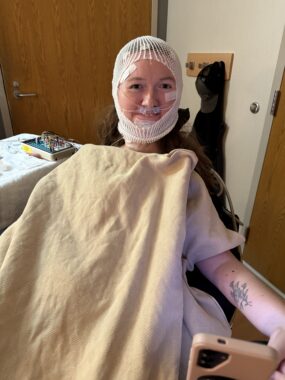
Columnist Brianna Albers is giving “old man” and “English court” vibes, according to her caregiver’s daughter. (Courtesy of Brianna Albers)
It took probably 45 minutes to get everything hooked up. By the time I crawled into bed, I was actually ready for bed. Unfortunately, then came the worst part of the entire night: a whole two hours without my BiPAP.
For someone who legitimately has sleep apnea, I kind of forget about it. My BiPAP is just something I wear so I don’t choke on my own spit in the middle of the night. The only time I’m really cognizant of it is when I have to sleep unaided. I rarely reach REM, or rapid eye movement, sleep because I’m constantly waking myself up with my shallow breaths. Sometimes I even stop breathing altogether and wake up with my heart in my throat, convinced that I’m dying of a heart attack. All in all, it doesn’t really lend itself to good sleep hygiene.
I was worried I wouldn’t actually fall asleep, but I must have, because at some point, a technician woke me up to put my BiPAP on. I was ecstatic! I could finally get some shut-eye! Mask secure, blankets pulled up to my chin, I prepared to drift off into the great unknown.
The next day, my pulmonologist would explain that the technicians had been experimenting with my BiPAP settings throughout the night to determine what would help me sleep best. Another thing I didn’t remember about sleep studies. So when my BiPAP settings started to change, seemingly at random, I was confused. Annoyed, even. I had no idea what was happening; I just knew that it was keeping me from falling asleep.
All in all, I got about six hours of sleep, none of which was particularly great. My dad and I left the hospital and met my mom at a nearby restaurant where I had some of the best waffles I’ve ever tasted.
Later that day, I met with my pulmonologist, who was kind enough to schedule me on such short notice. She went over the study results and told me I was an overachiever even when it came to sleep disorders. If I remember correctly, I had over 120 apnea events over the 120 or so minutes I was off BiPAP, averaging one a minute. I laughed and said I was happy to please.
Thanks for reading! You can follow me on Instagram and Threads, subscribe to my newsletter, or check out my website.
Note: SMA News Today is strictly a news and information website about the disease. It does not provide medical advice, diagnosis, or treatment. This content is not intended to be a substitute for professional medical advice, diagnosis, or treatment. Always seek the advice of your physician or other qualified health provider with any questions you may have regarding a medical condition. Never disregard professional medical advice or delay in seeking it because of something you have read on this website. The opinions expressed in this column are not those of SMA News Today or its parent company, Bionews, and are intended to spark discussion about issues pertaining to spinal muscular atrophy.



Leave a comment
Fill in the required fields to post. Your email address will not be published.