
Guest Voice: Embracing the beauty of imperfection as an artist with SMA
I was unable to run or play sports, but I could draw, and that made me feel unique
Written by |

My parents were the first to notice that I had some art talent.
Spinal muscular atrophy (SMA) wasn’t well understood when I was a child, and in an era before iPads, cellphones, and travel games, they used to let me entertain myself by doodling on the paper sheets on the exam tables in doctors’ offices.
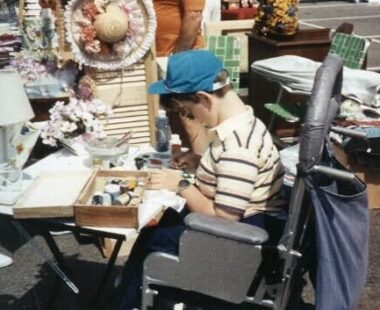
Eric Ovelgone began painting and drawing when he was a boy. (Courtesy of Eric Ovelgone)
Before I could speak, I was doodling recognizable images, often impressing the doctors. I depicted people on roller skates, as I imagined it was ordinary for people to get around on wheels like mine.
Art was an activity I could not only do as well as someone without a disability, but better than many able-bodied people. I was unable to run or play sports, but I could draw, and that made me feel unique.
My parents sent me for art lessons with a retired art teacher who basically adopted me as a grandson. My sister would push my wheelchair to his house once a week and bump it up the steps so I could go inside.

Priceless art
My eldest sister, who also has SMA, was studying art in college, and our family spent many weekends touring art galleries. During one of my first visits, I was struck by the reverence and awe that the patrons showed to the masterpieces.
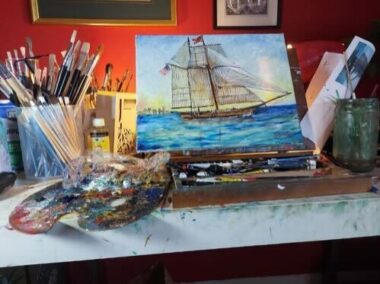
A peek inside Eric Ovelgone’s studio and at a recent painting. (Courtesy of Eric Ovelgone)
I remember asking my mother how much a particular painting was worth. In a hushed tone, she said it was priceless. The idea that something could be so important, so valuable, that a price couldn’t be affixed blew my mind, and I longed to create something that would be called priceless.
Although my disability hasn’t greatly limited what art I can do, it has created challenges that have forced me to do art in different ways. Because I must find unique ways to overcome obstacles, it’s opened unexpected avenues for creativity and given me new ways of doing things.
I sometimes must work on large canvases upside down or sideways, or even tape paintbrushes to dowels to reach. The change in perspective, much like viewing the world from a wheelchair, provides new insights.
One of my greatest insights happened when I was working with my art teacher to reproduce a photo of a gazebo surrounded by pine trees. Wanting to perfect my drawing, I sat for hours drawing every single needle, and when the picture was finished, it looked horrific.
At about the same time, “The Joy of Painting” with Bob Ross came on. With his paintbrush, he dabbled a beautiful forest of pine trees full of happy little mistakes. This brought me to the profound realization that there’s beauty in imperfection. Trees twist, bend, and break as they reach for the sky.
In my late teenage years, my art was primarily a source of additional income as I painted a variety of crafts. My father helped me cut the patterns that I drew out of wood, and I would paint them at customers’ request.
Taking it back up
By the time I started college, it became clear that the lifestyle of a starving artist wouldn’t be sufficient given my disability and the cost associated with it. My art was relegated to the backs of notebooks and an old, worn sketchbook I carried. I studied business and then computer programming.
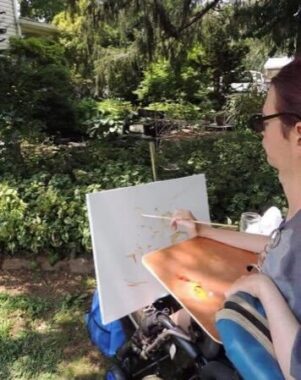
Eric Ovelgone continues to work from home as an artist, using various techniques and styles. (Courtesy of Eric Ovelgone)
When I started my first job, I thought my artwork, much like childhood toys, would be put away and forgotten. That is, until the day I couldn’t work anymore.
Many adults with disabilities get to a point where we can’t work, whether it’s due to transportation, aging caregivers, mounting health issues, or the accumulated fatigue of competing with able-bodied individuals while we’re falling apart. My purpose and meaning vanished, and no one understood. It was depressing to no longer be able to tell people I was a programmer. Who was I? That’s when art once again saved me from a dark place.
Now, I work from home using a wide range of mediums and topics. I enjoy everything from country craft art and traditional oil painting to computer graphics. I’ve had some minor recognition, including a painting displayed in a gallery and some minor awards. I occasionally sell my artwork, and I recently published an illustrated children’s book titled “Creatures A to Z,” and another called “Swoggle from Hoggendoggle.” When people ask me what I do, I can say I’m an artist.
Still, art generated by artificial intelligence (AI) poses a major threat for people like me and has cut off most of my income. Instead, I attend social art groups like the Sykesville Painting Club, and primarily work on art for myself that AI can’t replicate yet.
No one said that the life of an artist was easy, but just maybe, one day, some child in a gallery might look at one of my works and think: priceless.
Note: SMA News Today is strictly a news and information website about the disease. It does not provide medical advice, diagnosis, or treatment. This content is not intended to be a substitute for professional medical advice, diagnosis, or treatment. Always seek the advice of your physician or other qualified health provider with any questions you may have regarding a medical condition. Never disregard professional medical advice or delay in seeking it because of something you have read on this website. The opinions expressed in this column are not those of SMA News Today or its parent company, Bionews, and are intended to spark discussion about issues pertaining to spinal muscular atrophy.




Amy
What a wonderful story! I would love to see your work. Is it available online?
carol horvath
Amazing article to read about the struggles and tribulations from man who even with limitations can make such beautiful work .