MDA 2026: Trio of trials now testing Spinraza successor salanersen for SMA
Biogen hopes to use data to seek regulatory approval of once-yearly therapy
Written by |

Biogen has launched a trio of trials to test its new drug candidate for spinal muscular atrophy (SMA), salanersen, which aims to be a more convenient successor to the company’s approved SMA therapy Spinraza (nusinersen).
Salanersen would need to be administered just once per year.
The biotech company said it hopes to use data from these Phase 3 trials as a basis to apply for regulatory approvals of salanersen. All three trials will follow SMA patients — altogether, infants, adolescents, and adults — for five years, according to a company press release.
“Over the past decade, we have remained steadfast in our pursuit of scientific innovation to support the evolving efficacy needs of the SMA community. We are at an important juncture for our SMA portfolio as we look to … advance salanersen into registrational studies,” said Stephanie Fradette, head of the neuromuscular development unit at Biogen. A registrational trial is specifically designed to generate the definitive effectiveness and safety data required for regulatory approval.
“We are excited to share … the design of our salanersen Phase 3 studies,” Fradette added.
One of the Phase 3 trials, SOLAR (NCT07444476), will test salanersen in adults and adolescents with SMA. The design for that trial was shared this week at the Muscular Dystrophy Association (MDA) Conference 2026 in Florida. The poster was titled “The SOLAR study: Phase 3 Study to Evaluate the Efficacy and Safety of Salanersen in Participants Aged 15-60 Years with Spinal Muscular Atrophy (SMA).”

The SOLAR study is expected to enroll 90 people with SMA, ages 15 to 60, who have either never received any SMA treatment before or are taking the approved oral therapy Evrysdi (risdiplam). All participants will be treated with salanersen; those on Evrysdi will discontinue that therapy upon starting the study.
SOLAR trial of salanersen to involve 5 injections over 5 years
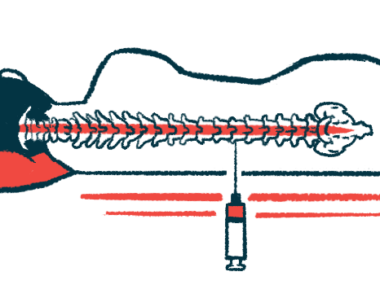
Salanersen is given by injection directly into the spinal canal, known as intrathecal administration, or more commonly, a spinal tap. The therapy is designed to work in a manner essentially identical to a high-dose formulation of Spinraza, which was recently approved in Europe and Japan and is under review in the U.S.
Spinraza needs to be administered every four months after loading doses. Salanersen, meanwhile, is designed to be given one time per year.
The SOLAR study is set to run for five years, meaning patients who complete it will have received five total injections.
As the SOLAR study represents a broad SMA population, in both age and disease subtype, data from the study may help inform both initiation of therapy and transitions between therapies in clinical practice.
The study’s main goal is to evaluate how an 80 mg dose of salanersen affects a standardized measure of motor function — the Hammersmith Functional Motor Scale-Expanded (HFMSE) — after one year in patients who were not on previous SMA treatments. There is also a range of secondary goals, including other measures of motor function and patient-reported outcomes. Safety and pharmacological assessments will also be conducted.
SOLAR will be conducted at approximately 50 sites worldwide. The study is expected to begin enrollment within the next few months.
“As the SOLAR study represents a broad SMA population, in both age and disease subtype, data from the study may help inform both initiation of therapy and transitions between therapies in clinical practice,” the researchers wrote.

2 other trials will test experimental therapy in infants
While SOLAR is testing salanersen in older SMA patients, the other two new Phase 3 trials aim to test the therapy in infants with the disease. The design of these studies was detailed at the MDA conference in a separate poster, titled “STELLAR Phase 3 Studies to Evaluate the Efficacy and Safety of Salanersen in Infants with Spinal Muscular Atrophy (SMA).”
One study, STELLAR-1 (NCT07221669), aims to enroll 30 babies up to 42 days old — 6 weeks of age — who have been diagnosed with SMA but have not yet developed symptoms of the disease. The other study, STELLAR-2 (NCT07444450), will recruit 42 infants as old as 7 months who have previously been treated with the one-time gene therapy Zolgensma (onasemnogene abeparvovec-xioi).
All participants in both studies will receive salanersen for five years. The main goal of STELLAR-1 is to assess how many children treated with salanersen reach certain motor milestones through up to five years of follow-up, while the main objective of STELLAR-2 is to evaluate the safety of salanersen when given to children who have previously received gene therapy.
“Data generated across STELLAR-1 and STELLAR-2 will provide insights on outcomes among infants who receive presymptomatic treatment with salanersen monotherapy, [Zolgensma] monotherapy, and [Zolgensma] followed by salanersen,” the researchers wrote. (Monotherapy refers to the use of a therapy on its own.)
Both STELLAR studies will be run at dozens of sites worldwide. The STELLAR-1 study is already recruiting presymptomatic newborns with SMA at sites in Texas and Virginia, while STELLAR-2 is expected to start recruiting patients later this year.
Note: The SMA News Today team is providing live coverage of the 2026 MDA Clinical & Scientific Conference March 8-11 in Orlando, Florida. Go here to see the latest stories from the conference.