SMA community honors legacy of disability rights activist Alice Wong
Author, who died in November, praised for her unwavering commitment
Written by |
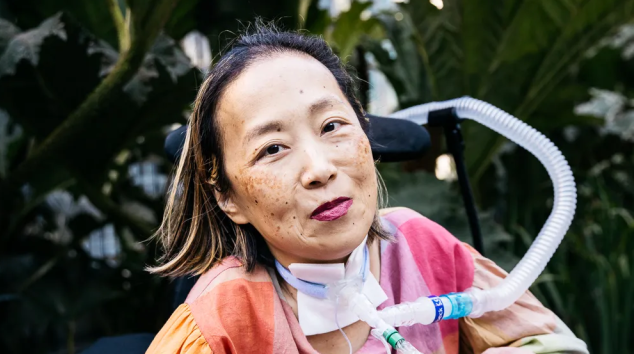
Advocacy activist Alice Wong helped transform disability culture. (By Allison Busch Photography)
Alice Wong, a disability rights activist with spinal muscular atrophy (SMA), devoted herself to fighting for the rights of people with disabilities and other underrepresented communities.
When she died at age 51 in November, she left behind a legacy of advocacy and action.
In her 2022 memoir, “Year of the Tiger: An Activist’s Life,” Wong described herself as a “disabled cyborg” — someone “tethered to equipment, technology, and electricity to keep alive.” (Wong relied on a powered wheelchair, an assisted breathing device, and, over the last few years of her life, a speech-to-text app to communicate.)
Alden Blevins, communications specialist for the National Disability Rights Network, saw Wong as a visionary advocate, storyteller, and movement builder whose work transformed disability culture.
“Her leadership, imagination, and unwavering commitment to the empowerment of people with disabilities will continue to guide all of us working in justice movements, and beyond,” said Blevins.

Confronting ableism from an early age
Throughout her life, Wong was a powerful advocate who worked to raise the visibility of those with disabilities. She challenged the societal systems and norms in the U.S. that favor non-disabled people.
“Alice Wong not only demanded equity in an inaccessible world, she reshaped the societal standard entirely, insisting the disabled population be seen as equally creative, talented, and diversely rich as the rest of humankind,” said Victoria Strong, executive director of the Gwendolyn Strong Foundation, an organization that helps fund SMA research and advocates for those with the neurodegenerative disorder.
Wong grew up in Indianapolis with her parents, who had immigrated to the U.S. from Hong Kong, and her two sisters. In her memoir, she discussed the bullying and discrimination that she faced growing up and how it ignited her steadfast resolve to confront what she saw as systemic ableism.
“The people who make the most impact are those who see what is wrong with the world while somehow being able, at the same time, to see what the world could be and should be,” said Tina Pinedo, communications director for the Disability Rights Education and Defense Fund. “Alice lived powerfully, fully intertwining priorities of disability justice, creativity, and community with an honesty that invited all of us to be braver.”

Building community through storytelling
One of Wong’s best-known accomplishments came in 2014, when she founded the Disability Visibility Project (DVP), a collaboration with the independent nonprofit StoryCorps that collects oral histories of Americans with disabilities. Many of these histories are housed in the Library of Congress.
The DVP also partnered with Wong on #CripTheVote, a nonpartisan online movement and social media campaign aimed at increasing political engagement and voting among people with disabilities.
“Alice and I first connected on Twitter,” shared Nicola Griffith, a writer who co-hosted #CripLit, a series of Twitter chats for and about disabled writers, with Wong. Griffith is also the author of “So Lucky,” an autobiographical novel influenced by her life with multiple sclerosis.
“We talked about the marvel of being able to connect this way with other disabled people, about how the tentacles of ableism were coiled about and strangling almost every aspect of crips’ lives. This, of course, includes our cultural lives.”
Committed to equity, access, and autonomy
Wong received the American Association of People with Disabilities Paul G. Hearne Leadership Award in 2016 for her foundational work with the DVP. Last year, she received a fellowship from the prestigious MacArthur Foundation.
“Alice’s wit and passion were unmatched, and she continually motivated disabled people to fight and to live life to the fullest,” said Kevin Schaefer, community editorial manager and SMA columnist for Bionews, which publishes SMA News Today. “Like me, she loved storytelling and used it as a tool for advocacy. She may be gone, but her legacy will live on.”
Ultimately, Wong imagined a world where people with disabilities, particularly those who are also part of marginalized groups, such as people of color, those in LGBTQ+ communities, and immigrants, could live without barriers and with complete autonomy over their lives and choices.
“At the Muscular Dystrophy Association, we carry on her tremendous legacy and the profound impact she has on disabled people — including so many in the SMA community like me — who saw themselves reflected in her work,” said Mindy Henderson, vice president of disability outreach and empowerment for the Muscular Dystrophy Association. “Alice’s commitment to equity, access, and the power of lived experience will continue to guide and inspire our movement for generations.”