
Finding representation and escape with SMA at Halloween
For one night, imagination gets the final word
Written by |

As the days get shorter and the temperatures get cooler, I find my thoughts turning toward Halloween costumes. As someone living with spinal muscular atrophy (SMA), I especially appreciate the imagination a costume can bring to a body and a wheelchair.
Forget the excessive sugar-rush candy and the tacky skeleton decorations; costumes are my favorite part of Halloween, everything from the simple to the sublime, as iconic as Superman and as ironic as Holy Guacamole. And I take them seriously enough that I have been known to reject trick-or-treaters who clearly haven’t put in the creative effort.
In recent years, some great wheelchair-adaptive Halloween costumes have hit the market, and it’s fun to scroll through Facebook photos of kids who have gotten very creative about transforming their wheelchairs into trucks, planes, and, well, Transformers. These costumes are clever and joyful because they make mobility devices part of the magic rather than something that must be hidden.
Representation matters
My brothers and I have always loved dressing up and using our imaginations — and we still do — so Halloween was a great excuse to go all-out. One year, my brother Andrew built Silver, the horse, around the sides of Kevan’s wheelchair so Kevan could ride into the evening as The Lone Ranger. Another year, I wore a satin nightgown and lipstick and lay in a little red wagon, pretending to be Sleeping Beauty. But these are the only childhood costumes I can recall that took our wheelchairs and disabilities into consideration. Most years, our chairs were beside the point. We were superheroes and Disney princesses, just like many other children.
-
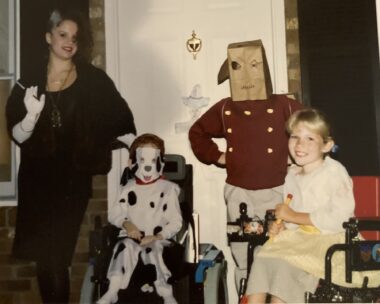
From left, cousin Melissa, brothers Kevan and Andrew, and Connie Chandler celebrate Halloween in 1990. (Courtesy of Connie Chandler)
And looking back, I can see the potential value of reimagining Cinderella, the Little Mermaid, and Wendy Darling as disabled characters. After all, representation matters. A disabled princess or adventurer can show a child that disability belongs in fantasy, beauty, romance, and heroism, not only in stories about struggle or inspiration.
But I really wasn’t thinking that at the time. In fact, I was thinking about all the ways I admired the characters I was portraying and everything I dreamed would be true in my own life. They were beautiful and graceful. They sang and danced, went on exciting adventures, and got to wear fancy dresses. And they all had happily-ever-after endings with a brave and noble hero.
And when I dressed up like that, their stories became my own for one special evening. I was not imagining that I was a disabled version of Cinderella. I was simply Cinderella, cleaning up after villainous stepsisters, talking with mice and birds, and dancing with a handsome prince. Perhaps that is why Halloween costumes still mean so much to me; for one night, imagination gets the final word.
There is something good in both kinds of costumes: the adaptive creations that turn a wheelchair into the centerpiece of an idea, and the costumes that allow our disability to fade into the background. One says, “This chair can be part of the adventure.” The other says, “This story belongs to me.”
Children with disabilities deserve both experiences. They should be able to see disability represented positively and imaginatively. But they also need opportunities to jump into familiar roles without having to explain, adapt, or reinvent them. Sometimes inclusion means making disability visible, and sometimes it means letting disability be only one detail in a much bigger story.
Costumes let children experiment with identity, courage, beauty, humor, and adventure. For a few hours, the question is not what their muscles can or cannot do. It is simply: “Who do you want to be?”
Note: SMA News Today is strictly a news and information website about the disease. It does not provide medical advice, diagnosis, or treatment. This content is not intended to be a substitute for professional medical advice, diagnosis, or treatment. Always seek the advice of your physician or other qualified health provider with any questions you may have regarding a medical condition. Never disregard professional medical advice or delay in seeking it because of something you have read on this website. The opinions expressed in this column are not those of SMA News Today or its parent company, Bionews, and are intended to spark discussion about issues pertaining to spinal muscular atrophy.




Leave a comment
Fill in the required fields to post. Your email address will not be published.