
Here’s why the accessibility in Frankenmuth, Michigan, impressed me
There's more to accessibility than making accommodations available
Written by |

It’s almost impossible for me to go places without silently analyzing the accessibility. I do it in my own city, but even more when we travel. After living with SMA for 29 years, it’s just natural to look around and quickly determine whether I can actually be a part of the space I’m in. Everywhere will probably have some imperfection, but more often than not, I’m at least a little impressed by something I find.
A few favorite features
Last month, we went on a long-weekend trip to Frankenmuth, Michigan, that my mom planned after analyzing the opportunities available and orchestrating the best possible ways to celebrate my birthday in the historic Bavarian community.

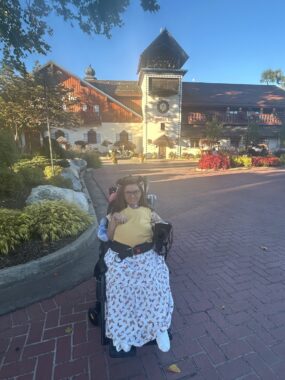
German-inspired buildings can be found everywhere in Frankenmuth, and they made beautiful photo backgrounds for a birthday getaway in September 2026. (Courtesy of Halsey Blocher)
Founded several hundred years ago, the German-inspired town was established long before accessibility became commonplace and a legal requirement in the United States, but while the area honors its rich history, I’m pleased to say it hasn’t left disabled visitors stranded in the past.
Most of Frankenmuth is connected by sidewalks, so we only drove our van once during our stay. The rest of the time, we walked (or rolled) everywhere, including restaurants, shopping districts, a festival, and casual explorations. While the weather was warm and beautiful during our stay, many sidewalks are also heated to melt snow and keep the paths barrier-free in the winter.
Made to resemble pathways found throughout Europe, decorative brick pavers and stamped concrete enhance the storybook atmosphere of the town, though it sometimes forces my body to move in ways it’s unaccustomed to, which can cause fatigue. Nonetheless, I enjoyed exploring with my family as we discovered more charm around every corner.
It was on one of our evening strolls that we came across a cool accessibility feature in front of the visitor center: a custom augmentative and alternative communication board, which allows those with communication challenges to point at symbols that represent what they want to say. This board was a clever way to promote inclusivity, alongside the city’s other accessibility features, and I appreciated seeing such an effort displayed right in the heart of a public location.
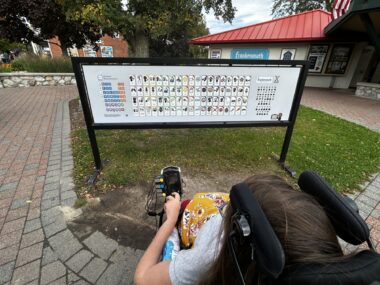
Displayed in the heart of Frankenmuth, the communication board promotes inclusivity and provides links to other accessibility resources. (Courtesy of Halsey Blocher)
While my case of SMA doesn’t prevent verbal communication — loss of speaking abilities can be a symptom of the disease, especially in type 1, which I have — we did encounter other accessibility features that provided me with opportunities to participate as a wheelchair user. Among those were some spectacular ramps (if you’ve never paused to admire an especially beautiful ramp, try it sometime). My favorite was probably the one I didn’t expect to find in a boutique.
Nearly every time we went somewhere, we passed this cute shop with even cuter clothes in the windows. But in all the times we went by, I couldn’t turn my head to look straight through the doors, which is why I didn’t notice until we entered that they opened onto a wide ramp that led to the elevated interior. The design, which was both beautiful and universally functional, enabled me to be a patron, and I ended up getting a purple skirt I otherwise might never have seen.
There was also the long switchback ramp connecting one of the plazas to the dock where the boat tour launches from. At the bottom, we were welcomed aboard by the captain and another ramp — this one detachable — spanning the distance between the platform and the lower level of the paddle wheel boat. Because my wheelchair could come with us, I was able to move freely around the interior and the viewing deck throughout the narrated excursion.
Where accessibility is actually created
Perhaps what impressed me most about our trip was the people we met. They were kind, thoughtful, and glad to celebrate with us. We even enjoyed meeting a fellow birthday girl when Mom asked if there was a special reason for her tiara. And a few servers came close to guessing my age! I’m almost always thought to be younger than I am, so I consider it a compliment when people recognize me as an adult and treat me like others my age.
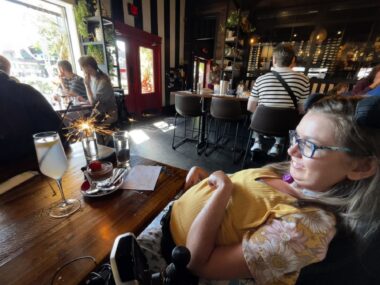
Halsey Blocher receives a sparkling surprise treat for her birthday after brunch at a new favorite restaurant in Frankenmuth. (Courtesy of Halsey Blocher)
Maybe some welcoming strangers seem out of place in a column about accessibility, but there’s more to it than building a physical space and making accommodations available. These people didn’t just make sure I could drive my wheelchair through the door. Whereas some would ignore my presence or view my needs as only a required service, they saw me as a person and made an effort to include me without being asked to.
True accessibility starts with intentionality, care for others, and willingness to learn from and about people who are different from us. The ways in which that becomes tangibly manifested are reflections of the heart behind the design. It stems from the people. And the people we met in Frankenmuth, Michigan, passed my accessibility analysis with flying colors.
Note: SMA News Today is strictly a news and information website about the disease. It does not provide medical advice, diagnosis, or treatment. This content is not intended to be a substitute for professional medical advice, diagnosis, or treatment. Always seek the advice of your physician or other qualified health provider with any questions you may have regarding a medical condition. Never disregard professional medical advice or delay in seeking it because of something you have read on this website. The opinions expressed in this column are not those of SMA News Today or its parent company, Bionews, and are intended to spark discussion about issues pertaining to spinal muscular atrophy.

Leave a comment
Fill in the required fields to post. Your email address will not be published.