
How I used a pink pamphlet to develop my self-advocacy skills as a child
A simple childhood craft allowed me to be genuinely seen by others
Written by |
My aunt, who doesn’t throw anything away, recently sent me an artifact from my childhood: a pink paper pamphlet titled “Meet Connie.” I was diagnosed with SMA type 2 when I was 18 months old and started using a power wheelchair when I was in first grade. Around the time I was in third grade, I told my mom that I was tired of my peers asking me about my wheelchair and wondering what was “wrong” with me. It felt like a barrier to making new friends, but I didn’t want to have to rehash to every stranger why my inability to walk didn’t mean I was broken.
It was the age of the “American Girl” book collection, and I loved them all. So my mom suggested I make my own “American Girl” book to introduce myself to people. We folded a piece of paper twice to look like a little booklet and taped a photo of me to the front. (We updated the photo a couple of times over the next few years.

Inside the book, my mom helped me craft a brief explanation of my disability in everyday terms, about three sentences total. Then we added a few more sentences about my family, my hobbies, my faith, and a few of my favorite things. We ended it with an invitation for the reader to be my friend. It was very sweet and simple.
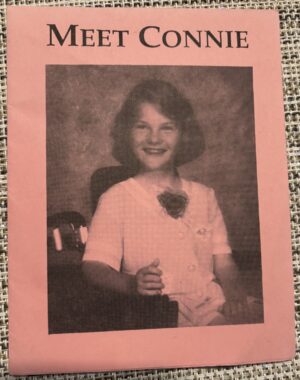
Columnist Connie Chandler’s self-advocacy story pamphlet, circa 1991. (Courtesy of Connie Chandler)
I remember keeping a handful of these booklets in a pouch (pink, of course) on the side of my wheelchair and handing them out to people I met everywhere I went. Maybe it was weird for some people, but it took the pressure off me to repeatedly answer the same hard questions. And I like to think that, even if they chose not to be my friend, they might learn something that would help them become a more informed, compassionate, and accepting person toward others in the future.
As I got older, I basically memorized the inside story like a personal elevator pitch, and I figured out how to adapt it to my audience, whether I was talking to a 3-year-old, a peer, or a grown-up. I became less dependent on those booklets and more confident in explaining SMA efficiently, then smoothly steering the conversation toward more relatable topics, like movies or food.
Looking back, “Meet Connie” was more than just a clever way for me to answer awkward questions; it was an early tool for self-advocacy. What started as a simple childhood craft ended up bridging the gap for me between being stared at and really being seen. It taught me a lesson I still carry with me: When we create practical and positive ways to share our stories, we invite connection with others rather than shut it down. And that has the potential to build deeper understanding, reduce discomfort, promote kindness, and make space for truly beautiful friendship.
Note: SMA News Today is strictly a news and information website about the disease. It does not provide medical advice, diagnosis, or treatment. This content is not intended to be a substitute for professional medical advice, diagnosis, or treatment. Always seek the advice of your physician or other qualified health provider with any questions you may have regarding a medical condition. Never disregard professional medical advice or delay in seeking it because of something you have read on this website. The opinions expressed in this column are not those of SMA News Today or its parent company, Bionews, and are intended to spark discussion about issues pertaining to spinal muscular atrophy.


Leave a comment
Fill in the required fields to post. Your email address will not be published.