
MDA Engage: Keynote speaker Mindy Henderson redefines the impossible
Advocate shares how questioning limits opens doors for the community
Written by |
Mindy Henderson has spent much of her life challenging the limits others have placed on her. When she was diagnosed with spinal muscular atrophy (SMA) — a genetic condition that causes muscles to weaken over time — as an infant, doctors told her parents that she might not live long and that school was not worth pursuing.
Her parents refused to accept that. They insisted on her education, a choice Henderson says changed the course of her life.
Today, Henderson serves as vice president of disability outreach and empowerment at the Muscular Dystrophy Association (MDA) and editor-in-chief of Quest Media. She’s also a motivational speaker, podcast host, and author of “The Truth About Things That Suck: and How to Make Them Suck Less,” a book about confronting adversity and finding practical ways to move forward.
On Sept. 25-26, Henderson will deliver the keynote address at MDA Engage: Chicago at the Westin Chicago Lombard. The free two-day event brings together individuals and families affected by neuromuscular diseases, including SMA, muscular dystrophy, amyotrophic lateral sclerosis, and myasthenia gravis, to share resources and build community. Her talk, “The Other Side of Impossible: Finding Strength, Hope, and Possibility Where We Least Expect It,” draws on her own life and work within the neuromuscular disease community.

Questioning the idea of the impossible
Ahead of the event, Henderson answered questions in a written interview with Bionews, the parent company of this site, about what she hopes attendees take away from her keynote, the moment her own life took a different path from what doctors predicted, and the advice she wishes someone had given her when she was first diagnosed.
One of the central messages she plans to share is that “impossible” is not always a fact.
“Sometimes it’s a conclusion we’ve reached based on what we’ve been told, what we’ve experienced so far, or what we can imagine from where we are today,” Henderson said.
However, that doesn’t mean pretending hard things aren’t hard, she cautioned. Henderson lives with a progressive condition, and the physical limitations are real.
“I’m not interested in telling people to simply ‘think positive,’ and everything will work out,” she said. “But I do believe there is often more room for possibility than we initially see.”
To Henderson, reaching the other side of “impossible” sometimes means accomplishing what everyone said couldn’t be done. Other times, it means redefining success, asking for help, or discovering a life path never previously imagined.
“I hope people leave a little more willing to question the assumptions — including their own — about what is possible for them,” she said.
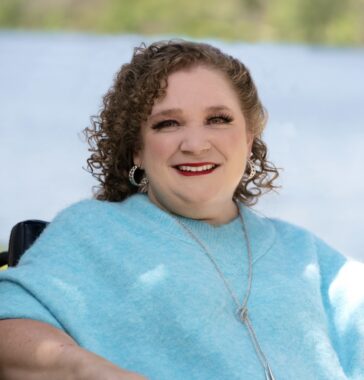
Mindy Henderson is vice president of disability outreach and empowerment at the Muscular Dystrophy Association. (Courtesy of MDA)
In a previous MDA press release, Henderson described the MDA Engage event as a space where scientific knowledge meets lived experience. While clinical updates are vital, she stresses that living well with a disability involves much more than what happens in a doctor’s office.
Community is what turns clinical information into practical tools, Henderson said. She hopes first-time attendees build real connections, exchange contact information, and find an enduring support system.
Growing up at a time when expectations for people with disabilities were often limited, Henderson proved those limits wrong by building a career in corporate America, leading advocacy efforts, traveling, and writing a book.
“Once you get to the other side of one ‘impossible,’ your relationship with the next one changes,” Henderson said. “You start to recognize that fear, uncertainty, difficulty, and impossibility are not the same thing.”
Her parents taught her early on that while expert medical opinions matter, “predictions are not destiny.”
“Expectations can either open doors or quietly close them before someone ever gets the chance to find out what they’re capable of,” she said.

Lessons from the neuromuscular community
Henderson finds it hard to point to a single story from the MDA community that has shaped her thinking, citing “volumes of evidence” that people with neuromuscular conditions are living rich, accomplished lives.
Every day, she sees individuals building businesses, raising families, advocating for policy changes, creating art, and navigating a world not always designed for accessibility.
“This community continually reminds me not to underestimate people based on a diagnosis or a disability — as I have been underestimated — and that there are countless ways to build a meaningful, fulfilling life,” she said.
Having been diagnosed with SMA as a baby, Henderson has no memory of life without a disability. Disability, she said, has always simply been part of who she is and how she moves through the world.
As a child, she attended MDA Summer Camp for eight years, where she felt a deep sense of belonging. Though she drifted from the disability community in her young adult years, she has reconnected with that community through her work at MDA, which she calls one of the unexpected gifts of the job.
“There is something incredibly valuable about being around people for whom you don’t have to explain everything,” Henderson said. “They understand the logistics, the frustrations, the humor, the workarounds, and the thousand little calculations that can come with living with a neuromuscular condition.”
That exchange of knowledge flows both ways. While she shares MDA resources with families, community members frequently introduce her to adaptive technologies, coping strategies, and fresh perspectives.
“Information is powerful,” she noted, “but information combined with lived experience and human connection can be transformative.”
”Expectations can either open doors or quietly close them before someone ever gets the chance to find out what they’re capable of.
Advice for the newly diagnosed
When asked what advice she would offer someone newly diagnosed with a neuromuscular disease, Henderson said: “Don’t let your diagnosis become a prediction of your entire future.”
She encourages individuals to learn about their condition, seek specialized care and resources, and explore available treatments, while keeping in mind that a diagnosis does not erase who they are as people. She stresses that patients remain whole people with distinct talents, ambitions, and lives to build.
She also advises seeking out peer support early rather than waiting for a crisis.
“Find people who understand some version of what you’re experiencing,” Henderson said. “You don’t have to model your life after theirs, but seeing the many different ways people build good lives with disability can expand your sense of what your own life might look like.”
Most importantly, she cautions against assuming limits on a future that has not yet unfolded.
“There will be challenges worth preparing for when they come,” Henderson said. “But there will also be opportunities, treatments, technologies, people, and possibilities you cannot see from where you are today.”
Note: The SMA News Today team is providing coverage of the MDA Engage Symposium. Go here to see the latest stories from the conference.


Leave a comment
Fill in the required fields to post. Your email address will not be published.