
Campaign expands accessible rental options for SMA vacationers
Rental platform teams with Novartis to add new properties to accessible network
Written by |

- SMA causes mobility limitations, making it difficult to find suitable vacation rentals.
- A new campaign expands accessible short-term rentals for SMA patients.
- The Becoming Rentable platform offers detailed filters to help people with SMA find accommodations.
A community-driven campaign called SMAshing My Limits And Going Places aims to make it easier for people with spinal muscular atrophy (SMA) to find accessible places to stay when they travel.
The campaign is spearheaded by Becoming Rentable, an online platform dedicated to helping people with disabilities find short-term rentals that can accommodate their needs. Becoming Rentable is teaming up with Novartis — which markets the SMA gene therapies Itvisma (onasemnogene abeparvovec-brve) and Zolgensma (onasemnogene abeparvovec-xioi) — to add approximately 100 new properties to the network.
The newly added properties will include yurts, cabins, and rentals near state parks and accessible beachfronts, with the ultimate goal of making all kinds of experiences easier for people with SMA to access, according to a press release announcing the campaign.
“As Becoming Rentable verified accessible short-term rentals for this campaign, we discovered accessible treehouses, domes, safari tents, and other unique places to stay that many people with disabilities might never have imagined were an option,” Lorraine Woodward, CEO of Becoming Rentable, told SMA News Today. “It reminded me that people don’t travel for the ramps or roll-in showers and that, at the end of the day, they’re really traveling for the experiences they can have. Accessibility is just what makes those experiences possible.”
Woodward and her two sons live with muscular dystrophy.
Knowing what to expect
Cory Lee, an advocate who lives with SMA type 2 and has used a power wheelchair since he was a child, is leading the campaign alongside Woodward. Lee has firsthand experience with the frustrations that can arise when traveling with SMA: He’s been to more than 50 countries across all seven continents.
“Growing up, I was often told that traveling would be too difficult or simply wasn’t possible for someone with my disability,” Lee said. “Thankfully, my mom encouraged me to dream big, and we started traveling together when I was young.”
Lee said he’s “learned that while travel can absolutely be more challenging for wheelchair users, it’s also incredibly rewarding.”
“That’s why I’ve dedicated my career to sharing accessible travel tips and showing others with disabilities, including people with SMA, that they can experience the world too,” said Lee. “My goal has always been to make travel feel more possible by helping people know what to expect and how to prepare.”
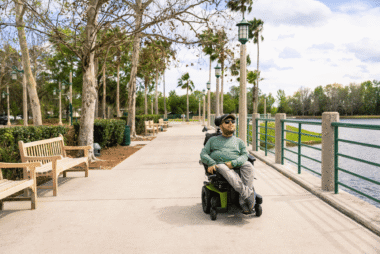
Cory Lee, who lives with SMA type 2, has traveled to more than 50 countries across all seven continents. (Photo courtesy of Novartis.)
SMA is a genetic disorder that affects motor neurons, the nerve cells that control movement. The disease can cause muscle weakness and poor muscle tone, resulting in a lack of muscle tension and floppiness. Many people living with SMA have significant mobility limitations and rely on adaptive equipment, such as power wheelchairs, to get around independently.
People with SMA often require specific accommodations that many lodging options do not provide. This is especially true of private short-term rentals, which generally are not required to comply with the Americans with Disabilities Act (ADA), as that law applies primarily to commercial properties.
There are about 1.5 million short-term rental properties across the U.S., but few are accessible to wheelchair users — and even when someone with a wheelchair can get inside, properties may lack features essential to meeting the unique needs of people with SMA.
“Even when a property says it’s ‘accessible,’ that description often doesn’t provide enough detail for someone with SMA or another mobility disability to know if it will actually meet their needs,” Lee said.
“For someone with SMA, knowing whether a property truly meets your accessibility needs isn’t just about convenience,” Lee said. “It’s about peace of mind. Details like doorway widths, roll-in showers, bed heights, lift availability, or whether there are steps somewhere along the route can completely determine whether a trip is enjoyable or stressful.”
Becoming Rentable’s online platform addresses this issue by allowing users to filter by dozens of accessibility features so they can find what’s right for them.
“One of the biggest lessons I’ve learned through my own family is that accessibility is never one size fits all,” Woodward said. “Even though my two sons and I all live with muscular dystrophy, our accessibility needs are different. A short-term rental that works perfectly for one of my sons may not work for me. That is why providing detailed, objective information is so important.”
Becoming Rentable allows users to see how wide a property’s doors are, whether there are steps in various places around the house, and what equipment is available in the shower. “These details matter because they can determine whether someone can independently enter, move through, and use a space,” Woodward said.
The ultimate hope is that this campaign will empower people with SMA to travel with more confidence.
“As two people living with disabilities that impact mobility and travel, we both understood the challenges, the frustrations, and the importance of making travel more accessible,” said Woodward. “We simply got it. Working alongside Novartis to help expand opportunities for accessible travel felt like a natural fit.”
Lee said feedback from the SMA community has been “incredibly encouraging.”
“I’ve heard from many people who said they finally felt seen because this campaign addresses a challenge they deal with every time they travel,” he said. “Others have shared that it has inspired them to start planning trips they previously thought were out of reach. That kind of feedback reminds me why these conversations are so important.”
“I would just encourage anyone with SMA who dreams of traveling not to let fear be the reason they stay home,” Lee said. “Yes, traveling with a disability often requires more planning, but that extra preparation can open the door to incredible experiences.”
“Travel has changed my life in countless ways, and I truly believe everyone deserves the opportunity to experience the world,” he said. “The more we work together to remove barriers, the closer we get to making that a reality.”
Among his many travels, Lee picks Antarctica as a personal highlight. “Seeing penguins and whales in their natural habitat was something I’ll never forget,” he said. “But honestly, some of my favorite memories aren’t tied to one destination. They’re the moments when I’ve been able to connect with people from different cultures and realize that travel has a way of bringing us together, no matter where we’re from or what challenges we face.”





Leave a comment
Fill in the required fields to post. Your email address will not be published.