
Finding joy in being there for someone who is there for me
Serving as my friend's maid of honor let me reciprocate the care she shows me
Written by |

I wiped away tears of happiness and hugged my friend Andrea. She was engaged to be married and had just asked me to be her maid of honor. Of course, I said yes with all the joy in my heart!
I love both her and her fiancé, watched them grow closer and fall in love, and have seen firsthand how good they are for each other. She has been one of my most faithful caregivers over the past few years as well. It meant so much to me that she wanted me to be by her side on her wedding day.
As the date got closer, though, my own doubts and anxiety set in — not about Andrea or the wedding, but about my ability to fulfill my maid-of-honor duties well. Because of SMA, my physical strength and stamina are low, and I’m very aware of the wedding-related tasks that might range from “tricky” to “impossible.” And while I was used to this friend being my caregiver, I would need to ask others to meet my needs that weekend so I could try to meet hers.

What if I ran over her dress and tore it or left a tire track? What if I ran over the best man? What if I caused a bridesmaid to trip and fall? Surely Andrea should have chosen someone else better fitted to the role.
These may seem like overdramatic thoughts, but living with a disability has taught me to anticipate any possible mishap and figure out how best to minimize the drama. I didn’t want to be in need while everyone else was busy, and I didn’t want to be the reason someone might have to interrupt the celebration.
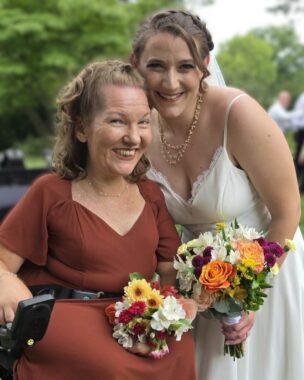
From left, Connie Chandler and Andrea Geans celebrate Andrea’s wedding day. (Courtesy of Connie Chandler)
But in the weeks leading up to the wedding, I was delighted whenever Andrea asked me to go with her to try on wedding dresses or pick out jewelry, try out hairstyles, approve color schemes, or talk through reception decisions. We went together to get manicures, scoped out photo spots, listened to her dance playlist, and rehearsed how she would arrange her bouquet in my lap to hold during the ceremony. And on more than a dozen occasions, she asked me to pray with her.
You see, Andrea didn’t choose me because I could pin fabric, lift boxes, or bustle a dress; she chose me because I had been part of her story. I knew the long and winding road, full of prayers and dreams and tears, that had led her to this man and this day. And so I knew that I could be steady for her in ways that did not require physical strength.
I did not perform the role perfectly, at least not by the traditional checklist of maid-of-honor duties. I still had limits and needed others to take on responsibilities I could not, but I got to be fully present for my dear friend. I provided messy tacos and girly cocktails to help her relax and unwind the night before; I kept a beaming smile and a reassuring nod ready for her anytime she needed to see it; I held space for this woman I admire as she stepped into a new chapter of her extraordinary life. And through it all, I was reminded that being there for someone is not dependent on what my arms and legs can do.
Andrea has shown up for me countless times in practical, tender, and even exhausting ways. On her wedding day, I wanted to reciprocate that kind of care. I was able to be there for her because she had already taught me what presence looks like: honest, flexible, imperfect, and full of love.
Note: SMA News Today is strictly a news and information website about the disease. It does not provide medical advice, diagnosis, or treatment. This content is not intended to be a substitute for professional medical advice, diagnosis, or treatment. Always seek the advice of your physician or other qualified health provider with any questions you may have regarding a medical condition. Never disregard professional medical advice or delay in seeking it because of something you have read on this website. The opinions expressed in this column are not those of SMA News Today or its parent company, Bionews, and are intended to spark discussion about issues pertaining to spinal muscular atrophy.


Diana Elizabeth Baker
This was such a neat article and I loved seeing your picture as a beautiful Maid of Honour!! So happy for you to have this privilege and honour Connie, for you surely deserve to have these special moments in your life! Are you working at this new job now, as a columnist for BioNews?
Love you!
A. Diana