
Finding joy in physical therapy and strength through creative play
Creative and adaptive play can support movement that feels possible
Written by |

Some of my earliest memories are of my mom helping me get dressed up for ballet. Nothing says prima ballerina vibes like a leotard, some tights, and chunky 80s-style leg warmers.
I was 4 years old, and I wasn’t actually going to a ballet lesson; I was going to my weekly physical therapy appointment. But in my imagination, I was a classic “bunhead,” and even dragged along my own barre (conveniently multi-purposed as a walker).
I was diagnosed with spinal muscular atrophy (SMA) in 1985, and back then, very little was known about the disease, and even less about what families should do next. Most pediatricians could only shrug and send parents home with their child’s diagnosis, and without a confident prognosis or goals-based treatment plan. I didn’t have a regular neurologist assigned to my case for 30 years, because there was nothing they could do for me. The doctors who initially diagnosed me (by way of a muscle biopsy) prescribed a walker and recommended physical therapy to keep me actively moving for as long as possible.

I remember going to my physical therapist’s home and playing with an assortment of toys in her wood-paneled basement. I sat on a bouncy therapy ball and tried not to roll off while the therapist knelt beside me, ready to catch me if I did. I arranged colorful magnets and stickers on a board on the wall, played an infuriating magnetic fishing game, and blew cotton balls across a tabletop with a straw. These may not seem like extreme workout tasks to others, but for me, they helped maintain my balance, range of motion, fine motor skills, and respiratory health in ways that were fun, engaging, and effective.
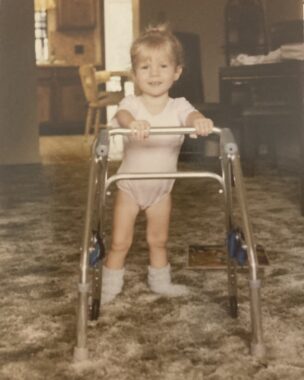
Connie Chandler, circa 1986, is ready for pediatric physical therapy. (Courtesy of Connie Chandler)
What I didn’t understand then, but appreciate now, is that creative play made physical therapy less about fixing what was weak and more about discovering what my body could do, and giving me the desire to keep doing those things. Play is not just a consolation prize for children with disabilities, something they are given conditional permission for after they have put in the hard work to check off a list of clinically prescribed exercises. Play can actually be the work: a meaningful, motivating way to build strength, stamina, coordination, confidence, and joy.
My mom was always present for these physical therapy sessions, and she learned a lot by observing what was happening in that setting. Outside of that basement, she found ways to keep the momentum of therapy going in my everyday activities. I swam in the pool, pumped my legs on the swing set, pushed around a toy vacuum cleaner, dressed my Barbie dolls, danced to the radio, and, yes, even did ballet moves at my walker-barre. These toys were not just distractions for me; they were invitations to actively participate in my own care and growth, one imaginative challenge at a time.
I think about the kids I know now who are growing up with disabilities, and all the ways their families are invested in their development. There’s the little boy who is paraplegic, who delights to go kayaking with his dad, unaware that his core muscles are being strengthened for stabilization in the process. There’s the little girl whose spastic joint muscles automatically relax more when she’s lying on a yoga mat next to her mom, and they are wearing matching yoga pants and scrunchies in their ponytails and doing their stretches together. There are the siblings who play Jenga, not realizing that the longer the game continues and the more exciting the stakes get, the higher they are stretching and reaching up to pile on the bricks.
Every moment does not need to be intentionally structured as therapy, and children should not feel as if their bodies are constant projects. But creative and adaptive play, guided by people who understand a child’s unique needs, can support movement that feels possible. So I encourage families and communities to look for the game inside the goal and give children with disabilities more chances to joyfully discover what their bodies can do.
Note: SMA News Today is strictly a news and information website about the disease. It does not provide medical advice, diagnosis, or treatment. This content is not intended to be a substitute for professional medical advice, diagnosis, or treatment. Always seek the advice of your physician or other qualified health provider with any questions you may have regarding a medical condition. Never disregard professional medical advice or delay in seeking it because of something you have read on this website. The opinions expressed in this column are not those of SMA News Today or its parent company, Bionews, and are intended to spark discussion about issues pertaining to spinal muscular atrophy.


Leave a comment
Fill in the required fields to post. Your email address will not be published.